Canary Insurance Group: Launching a Boutique Brand in a Regulated Market
TL;DR:
- Challenge: A seasoned professional liability specialist launching her own boutique agency needed a credible brand, a compliant website, and a way to filter leads, with zero technical burden on herself
- Approach: Brand identity, regulatory-compliant content, and a fit-screening intake, built through an AI Reformation process with AI doing the heavy lifting under one connected workflow
- Result: A live, compliant brand and website with a clear boutique position in a market dominated by large networks
At a Glance
| Metric | Result |
|---|---|
| Client | Canary Insurance Group |
| Founder | Cari Senefsky |
| Industry | Insurance / Professional Liability |
| Location | Texas |
| Challenge | Launch a credible boutique brand in a strictly regulated market, with a non-technical founder |
| Solution | Brand identity, compliant website, and fit-screening intake built through an AI Reformation process |
| Outcome | Live, compliant brand and website with a defensible boutique position |
The Challenge: A Reputation Without a Home
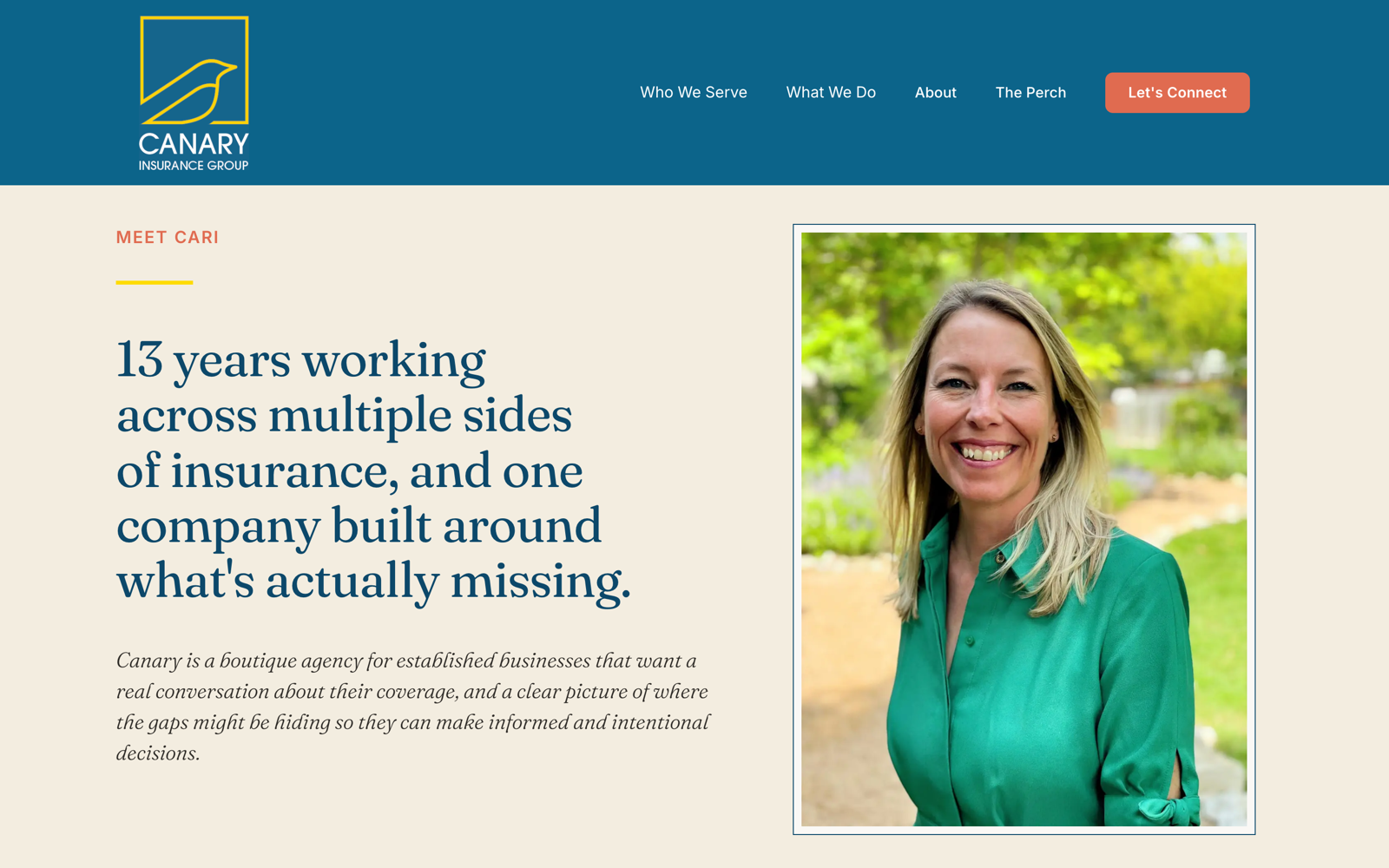
Cari Senefsky spent 13 years in professional liability and management lines. She worked the carrier side, the broker side, and the retail side. She held a director role at a state insurance association and a marketing role inside a national brokerage. The expertise was real and the relationships were already there.
What she didn't have was her own company. Leaving an established organization to launch a boutique agency meant starting with a name nobody recognized yet. When she announced the move, she needed somewhere credible to send people. A prospect who heard about her would look up the firm, and the site they found had to confirm the reputation she'd already built, not raise a question about it.
Two constraints shaped the work. First, insurance is regulated. Advertising rules govern what an agency can claim, how it can describe coverage, and what it can say before licensing clears. Copy that ignores those rules has to be torn out and rewritten. Second, Cari is not technical and didn't want to be. She wanted to place coverage and talk to clients, not manage a web build.
She also wanted the brand to say something specific. Not another generic agency competing on price and speed. A boutique firm built on direct relationships, honest assessments, and coverage that fits what a business actually does.
The Approach: Build the Business, Then Pick the Tools
This was a launch, not a redesign. There was no old website to fix and no legacy process to protect. The starting question was how the business should present and qualify itself, and the technology followed from the answer. That operating-model-first approach is what MODEFORGE now brings to AI Reformation engagements: decide how the work should run, then build the system that runs it.
Position Before Pixels
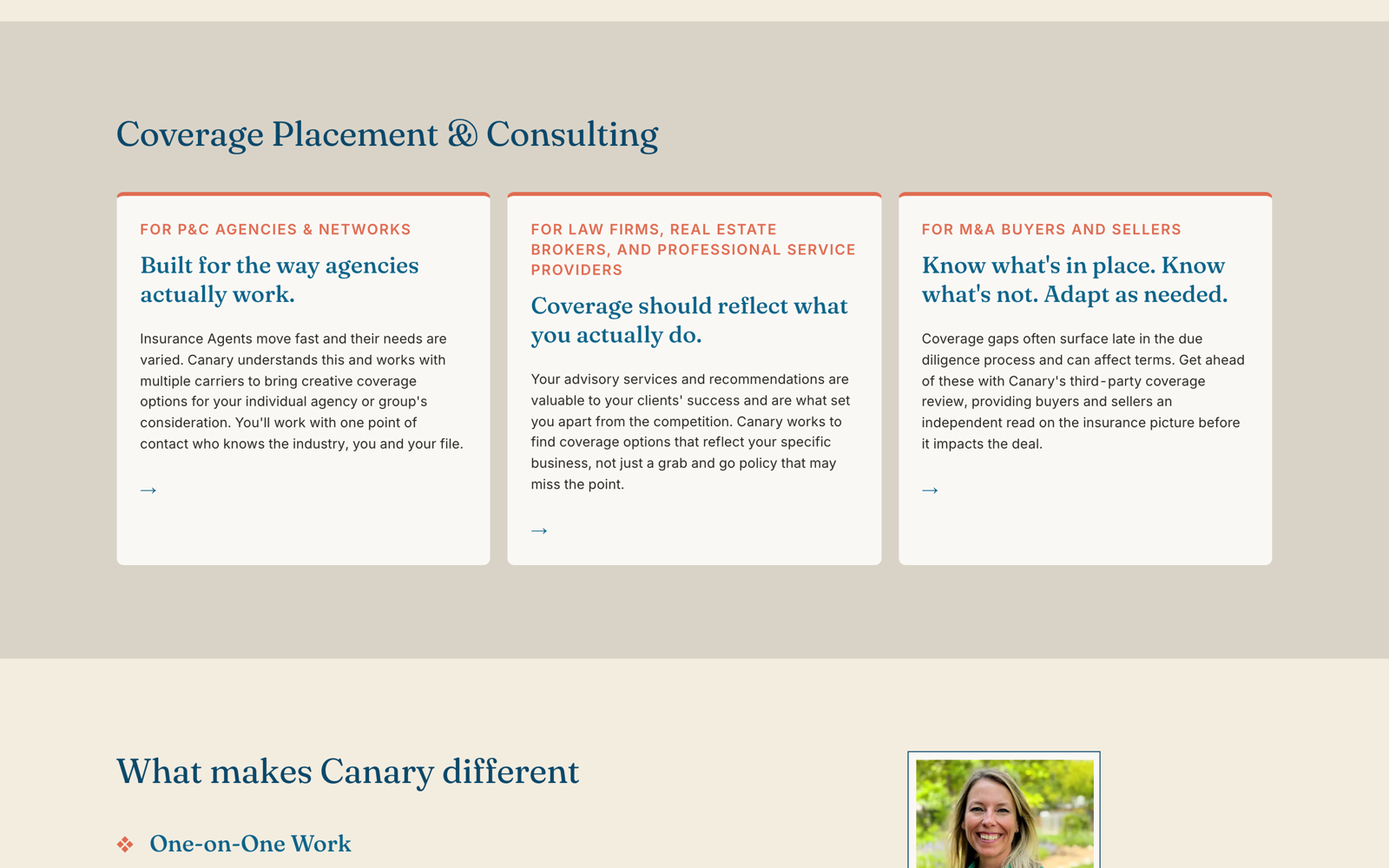
The first work was positioning, not design. Canary serves a specific audience: insurance agencies, law firms, real estate brokers, and professional service providers who want a specialist, not a membership program. The brand makes that trade explicit. You work with the person who understands your business and your file, not a call center. Coverage should reflect what you actually do.
A Brand With a Point of View
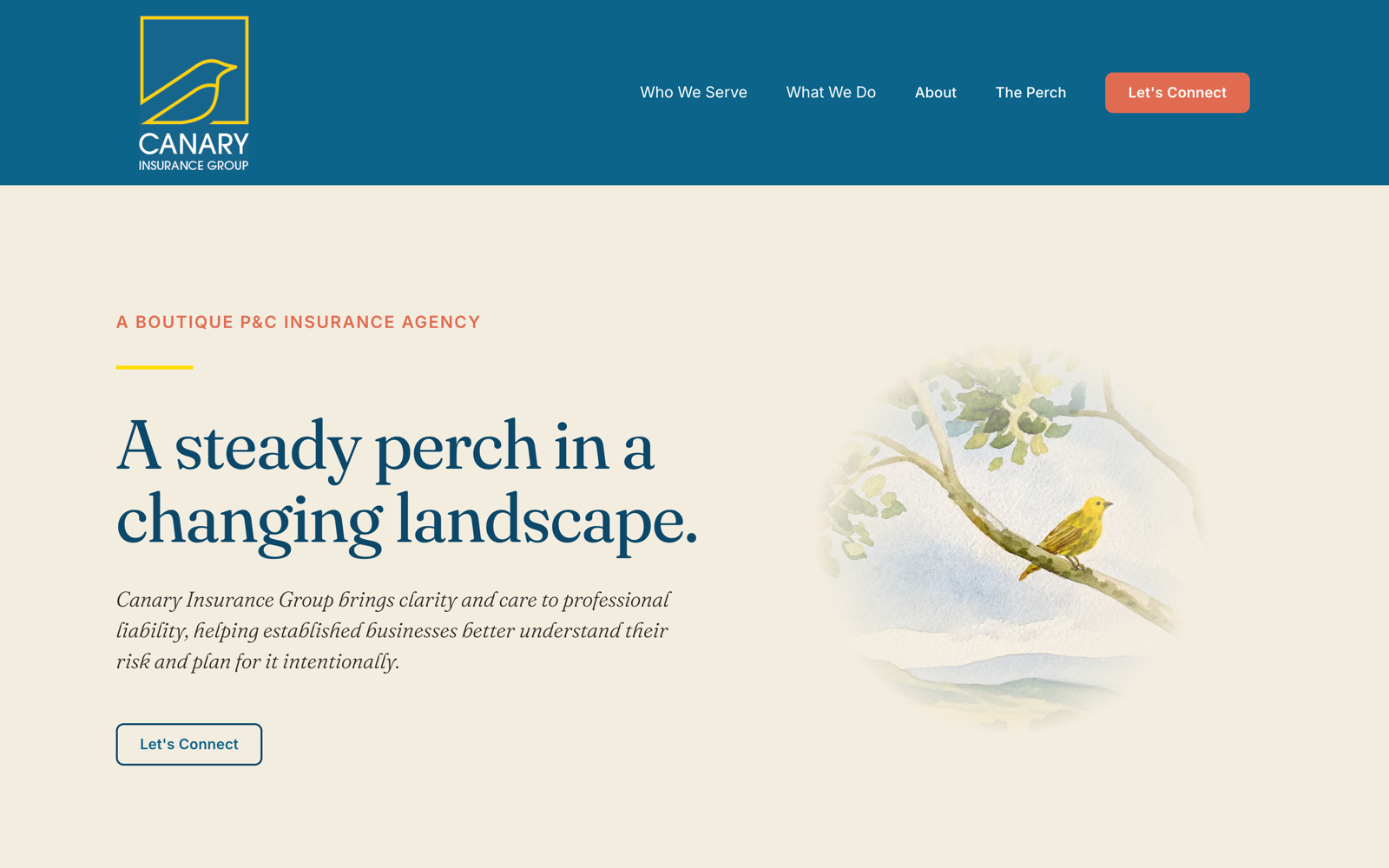
The name carries the idea. A canary notices change in its environment early, before anyone else feels it. That became the spine of the identity: "a steady perch in a changing landscape." The visual direction draws on the Texas Hill Country where the firm is based, with the canary as a recurring character rather than a logo dropped on a stock photo. The result is warm and specific, the opposite of the gray corporate template most agencies settle for.
Compliance Built In, Not Bolted On
In a regulated industry, the compliance work usually happens last, as a legal review that strips the life out of finished copy. We ran it the other way. The advertising rules shaped the writing from the first draft, so the brand voice developed inside the limits rather than against them. Cari got copy that sounds confident and clear because nothing had to be softened or removed after the fact.
Intake Designed to Qualify
A boutique agency lives or dies on who it spends time with. The website's intake is a guided conversation, not a generic contact form. It mirrors how Cari actually works: understand the business first, find the gaps, then place coverage with real carrier options. The flow screens for fit, so the prospects who reach her are the ones she can genuinely help.
How It Was Built
The reason a solo founder could get a complete brand, a compliant website, and a working intake system as one connected effort is the method underneath. This was an AI Reformation engagement. AI did the heavy lifting across brand development, compliant content, and the qualification logic, under a single workflow rather than a chain of separate vendors. The output is the kind of infrastructure that usually takes a much larger team, delivered for one person who never had to touch the technical side.
The Results
- A defensible boutique position: Canary stands apart from the bureaucratic networks and call centers it competes with, built on specialization and direct relationship
- Compliant from day one: The brand and website clear insurance advertising rules without reading as cautious or generic
- A live, credible presence: The reputation Cari earned over 13 years now has a home that matches it, ready to link to the moment she announces her move
- Qualification built into intake: The guided flow screens prospects for fit, so the founder spends her time on the businesses she can actually serve
Key Takeaway
A solo founder doesn't have a large team, a long runway, or time to manage a stack of vendors. What she has is expertise and a window to launch. Building the business on AI from the start closes the gap: brand, compliant website, and a working lead system delivered as one effort, so the infrastructure matches the ambition instead of trailing behind it.
Frequently Asked Questions
How do you build a brand and website for a regulated industry like insurance?
You build the compliance in from the first draft instead of editing it back in later. Insurance advertising rules govern what an agency can claim, how it describes coverage, and what it can promise before licensing clears. The work starts with the rules, so brand voice and page copy are written inside those limits from the beginning. The result reads as confident and clear rather than cautious, because nothing has to be walked back.
Why does a boutique agency need a strong digital presence?
A boutique agency competes on trust and specialization, not scale. When a prospect hears about a small firm and looks it up, the website is the first proof that the firm is real and serious. For a founder leaving a larger organization to start out on her own, the site has to confirm the credibility she already earned. A strong digital presence closes the gap between a personal reputation and a brand new company name.
What does AI Reformation mean for a solo founder or small business?
AI Reformation means building the business on AI from the start rather than adding tools to an existing process. For a solo founder, that shows up as speed and coherence: a complete brand, a compliant website, and a working intake system delivered as one connected effort instead of a series of disconnected vendor projects. The founder carries no technical burden and gets infrastructure that usually takes a much larger team to produce.
How do you position a new agency against established insurance networks?
You lead with the thing the large networks cannot offer: direct access to one specialist who understands the client's business and file. Canary's position is built on specialization and personal relationship, framed against bureaucratic membership programs and call-center service. The brand makes the trade explicit, so the prospects who value a direct relationship self-select toward it.
What is an M&A coverage review?
An M&A coverage review is a third-party assessment of an organization's insurance before a sale or acquisition. It checks whether current policies match what the business actually does, flags gaps that could surface during due diligence, and gives buyers and sellers an independent read on exposure. For professional service firms and agencies, it is a way to enter a transaction without coverage surprises.
Services Provided
- Brand identity and visual direction
- Website design and development
- Regulatory-compliant content for a licensed industry
- Lead qualification and guided intake
- AI Reformation engagement delivery