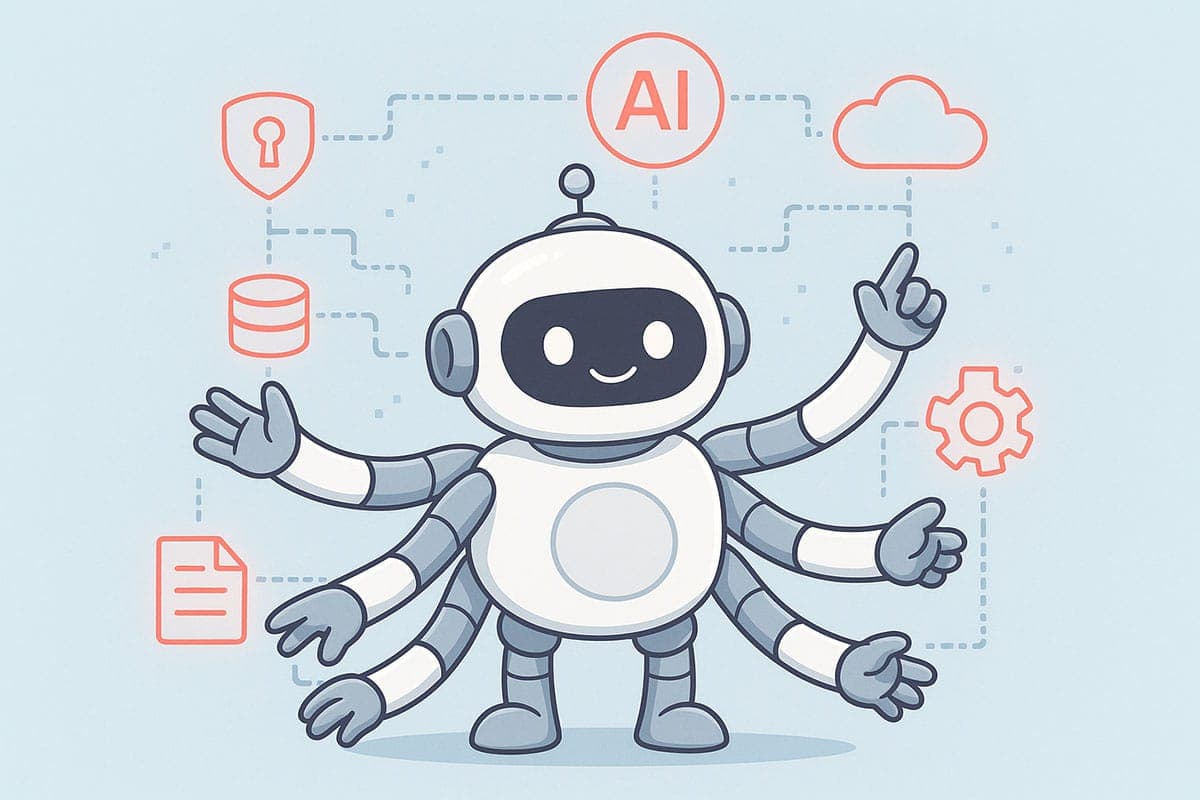
Model Context Protocol (MCP) for B2B Businesses
TL;DR: The Model Context Protocol is an open standard that transforms AI from isolated tools into operational infrastructure. MCP enables AI to access enterprise data, execute tasks with permissions, and automate workflows with full auditability. For B2B companies, this creates 30-70% efficiency gains and competitive advantages that compound over time.
How a New AI Standard Reshapes Enterprise Efficiency
Artificial intelligence is evolving beyond tools and models into full business ecosystems. For B2B companies, the next decade will be defined by how effectively they integrate AI into workflows, customer experiences, and operations. Yet most organizations remain stuck at the experimentation stage, using AI tools rather than building AI infrastructure.
The Model Context Protocol represents the next significant shift in enterprise AI. Unlike individual models or chat interfaces, MCP is an open standard that allows AI systems to safely and securely interact with an organization's data, tools, and operational environment. It's designed for interoperability, security, and operational automation at scale.
For executive teams evaluating how to modernize workflows or prepare for AI-driven markets, understanding MCP is foundational. MCP will influence enterprise architectures the same way APIs, cloud services, and mobile platforms reshaped the previous generation of digital transformation.
What MCP Actually Is
Most business leaders interact with AI through tools like ChatGPT, Claude, or Perplexity. These tools answer questions, generate content, or summarize information, but they operate as isolated applications. Powerful, but not integrated into day-to-day operations.
The Model Context Protocol changes this.
At its core, MCP is a technical specification that allows AI systems to:
- Access data sources directly
- Interact with software tools
- Perform defined operations safely and with permission
- Maintain structured context while doing so
- Integrate into enterprise systems in a consistent, auditable way
The simplest framing: if APIs were the connective tissue of the cloud era, MCP is the connective tissue of the AI agent era.
APIs allow software systems to talk to each other. MCP allows AI systems to talk to software systems, databases, and tools in a controlled and standardized way.
This creates an architectural shift. AI is no longer a separate application used by humans. AI becomes an operational layer inside the business, capable of retrieving data, performing tasks, and triggering workflows. And it does this within permissions, security boundaries, and compliance requirements defined by the organization.
Why MCP Matters for B2B Enterprises
The B2B marketplace is being reshaped by AI-driven expectations. Companies want faster onboarding, richer data insights, accelerated procurement cycles, and proactive communication. Internally, teams need better decision support, more automation, and fewer manual processes.
MCP enables transformation by solving five persistent problems in enterprise AI adoption.
1. AI Has Limited Access to Enterprise Systems
Most AI tools operate in isolation. They can't read your ERP data, update CRM records, run internal reports, access your knowledge base, or interact with proprietary tools. MCP removes this limitation by creating a secure bridge between AI models and enterprise tools.
2. AI Lacks Domain Context
Large language models are generalists. They know how to write, analyze, and reason, but they don't know your business unless you manually feed them information. MCP introduces persistent, structured domain context that travels with the AI, ensuring consistent accuracy.
3. AI Tools Don't Integrate Into Workflows
AI doesn't improve efficiency if employees must copy and paste content into a chatbot. MCP turns AI into a workflow participant that plugs directly into operational tools.
4. Security and Compliance Concerns Limit Adoption
Executives hesitate to expose internal data to AI systems for good reason. MCP solves this through controlled permissions and a standardized access layer. Organizations define exactly what an AI system can see and what operations it can perform.
5. AI Value Isn't Compounding
Without deeper integration, AI becomes a novelty rather than an operational force multiplier. MCP supports compounding ROI by enabling system-level automation, cross-functional workflows, enterprise memory, repeatable processes, and continuous improvement loops.
How MCP Works in Practice
Imagine an AI agent operating with controlled access inside your company's environment. It can:
- Read data from your CRM
- Summarize activities from your project management tool
- Pull financial records from your accounting system
- Draft reports based on internal templates
- Update records with proper audit trails
- Trigger workflows within approved boundaries
- Retrieve knowledge base articles for employees or customers
All performed through MCP connectors defined by your engineering team or technology partners.
MCP doesn't replace existing systems. It enables AI to interact with them safely.
The Four Core Components
Resources. Data sources that an AI system can read. Examples: CRMs, ERPs, documentation repositories, data warehouses, shared drives.
Tools. Actions an AI system can execute. Examples: create a ticket, update a CRM contact, draft a contract from a template, schedule a meeting, run a financial report.
Prompts. Predefined structures ensuring consistent, accurate outputs. Prompts become reusable instructions embedding company standards.
Sessions. Controlled environments where AI interacts with tools and data. Everything is logged, permissions governed, and context preserved.
Together, these elements create a secure, auditable, operational AI layer within the business.
Strategic Use Cases for B2B Leaders
Sales Operations
AI becomes a true revenue operations assistant:
- Pull CRM activity and summarize pipeline health
- Draft sales emails using account history
- Build account plans from internal templates
- Analyze forecast accuracy
- Update CRM fields with clean, structured data
- Build proposals from product catalogs and pricing rules
Result: better pipeline accuracy, higher sales productivity, cleaner CRM data.
Customer Success
AI takes on routine tasks:
- Review support tickets and identify themes
- Draft QBR decks using customer usage data
- Monitor account risks using internal signals
- Summarize contracts or renewals
- Prepare onboarding steps for new accounts
Result: higher retention and better customer experience.
Professional Services
AI sits inside project workflows:
- Read project management data
- Flag risks based on budget and timeline trends
- Prepare status reports
- Draft meeting agendas from task boards
- Identify overdue tasks and notify owners
Result: improved delivery consistency and reduced administrative overhead.
Finance and Accounting
AI supports financial operations:
- Pull invoices and categorize them
- Draft financial summaries
- Reconcile transactions using internal rules
- Identify anomalies in cash flow or expenses
- Prepare budget variance reports
Result: faster reporting cycles and greater financial accuracy.
The Executive Impact
Operational Efficiency
AI becomes a workflow participant, not a separate tool. Typical impacts include:
- 30 to 70 percent reduction in routine administrative work
- Shorter cycle times for reporting, communication, and reviews
- Higher data accuracy across systems
- Lower operational friction across departments
This isn't traditional automation. It's dynamic, intelligent workflow participation.
Revenue Growth
MCP doesn't directly generate revenue, but it amplifies systems that do:
- Higher sales productivity
- More accurate forecasts
- Faster proposal creation
- Better retention performance
- Greater customer lifetime value
Companies that adopt MCP early will see compounding advantages as AI-powered workflows mature.
Competitive Differentiation
Most companies will spend years experimenting with AI tools. Few will integrate AI into the actual operating system of the business.
MCP allows organizations to:
- Move from tool adoption to system transformation
- Build proprietary AI workflows that competitors can't easily replicate
- Create more predictable, data-driven operating rhythm
- Strengthen cross-functional collaboration
This is a differentiator on the same level as cloud transformation in the 2010s.
Key Takeaway
AI won't replace businesses. But businesses that integrate AI deeply will outperform those that stop at experimentation. MCP is the bridge from experimentation to transformation.
Related Resources
- AI Readiness Assessment Guide - Find out if your business is ready for AI integration.
- AI Reformation - Learn how ground-up AI integration transforms how businesses run.
- Start a Conversation - Ready to explore what AI can do for your business?
Frequently Asked Questions
What is the Model Context Protocol (MCP)?
MCP is an open standard that allows AI systems to safely interact with an organization's data, tools, and operational environment. It enables AI to access data sources directly, execute defined operations with permission, maintain structured context, and integrate into enterprise systems with security and auditability. Unlike chat interfaces, MCP makes AI an operational layer inside the business.
How does MCP differ from APIs?
APIs allow software systems to communicate with each other. MCP allows AI systems to communicate with software, databases, and tools in a controlled, standardized way. If APIs were the connective tissue of the cloud era, MCP is the connective tissue of the AI agent era. The key difference is that MCP is designed specifically for AI interaction, including context management, permission control, and audit trails.
What are the four components of MCP?
MCP uses four core components: Resources (data sources AI can read like CRMs and ERPs), Tools (actions AI can execute like creating tickets or drafting contracts), Prompts (predefined structures for consistent outputs), and Sessions (controlled environments where AI interacts with tools and data with full logging and permissions).
What efficiency gains can MCP deliver?
MCP typically delivers 30-70% reduction in routine administrative work, shorter cycle times for reporting and communication, higher data accuracy across systems, and lower operational friction across departments. These gains come from AI participating in workflows directly rather than operating as isolated tools that require manual data transfer.
Topics Covered
- Model Context Protocol (MCP)
- Enterprise AI integration
- B2B AI strategy
- AI workflow automation
- AI governance and security
- Operational efficiency
- Digital transformation